
HISTORY OF BRADNINCH
The Hele Society, for information on the history of Hele, can be contacted on potterselm@yahoo.co.uk
- To outsiders, Bradninch is often looked upon as a village, but it is in fact a town, and has been since the beginning of the 12th century, when it received its first charter from Reginald de Dunstanville, a son of Henry I.
- Bradninch dates back to before the 7th century and at this time there was a wooden fortress on Castle hill. This was one of the fifteen important fortresses in the South West at that time. There would have only been a few buildings at that time mainly to the north and east of were the Church is now.
- The meaning of the word Bradninch is not generally known. but it was probably derived either from Bradeneche, the Saxon word for broad ash, broad oak or from the earliest references, Braenes and Branes. Celtic for hill is bre (brea) or bryn and today we use the word brae for hillside, suggesting Bradninch be a place by a hill or hillside which it is.
Bradninch During the 2nd World War
Letters and Emails Received
Memories, after 60 years begin to fade in your mind. I am close to 80 years of age now. However, I do remember some things. Our Quonset huts were in a field on the southern fringe of the town. I do remember when we would want to go to town we would make a left out of the encampment and then a left on to the main street.
I do not remember any of the names of the streets. As we walked north on the street the fish and chip shop was on the left side of the street and the bakery and some kind of restaurant was across the street.
I would have remembered a candy shop if there was one as sweets were, and still are one of my weaknesses. I suspect since there was rationing at the time candy was in very short supply. I do not remember anyone by name, but I do recall that people were generally very friendly. Of course the British soldiers resented us somewhat.
They used to call us, “Bloody Yanks” and they said the problem with us was that we were: Overpaid—Oversexed and Over Here (England.) It was all good natured and we really got along well during some very tough times. I can remember going to Exeter, Torquay (not sure I spelled that right.) I also had a little time before D-Day to go to London.
I was there during some of the air raids and can remember how brave the people were. We stayed at a Red Cross Hostel of some kind. I think it was called, “Columbia” As far as I know there has never been a reunion of my outfit, I have lost touch with all of the men in our battery. We were in Battery C, 955th Field Artillery Battalion which was part of Fifth Corps, First Army. We fired 155mm howitzers during the war.
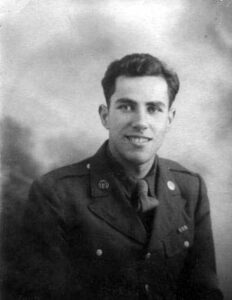
I don’t remember any dances in Bradninch when I was there. By the way wasn’t it Bradnich originally? I may have some photos of when I was in Bradninch and I will look for them. If and when I find them I will send them.
I am attaching a picture taken of me in Bradninch in 1944. I was in London on vacation about 7 years ago and my wife and I loved every minute we were there.
If our health holds up, we hope to come again and see more of England and possibly Bradninch at that time.
Kind regards,
Murray Weiss
Haydon’s Bakery
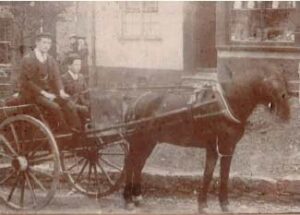 After seeing the pictures of Bradninch in the “Then and Now’ section, I was very interested when I saw the reference to the bakehouse on #31 Fore Street about the oven being discovered behind the wall in the now renovated kitchen.
A short history of the bakehouse at #31 Fore St. is as follows: Richard Haydon (1850 & 1856); Samual Haydon (1870); William Haydon (1878 to 1891); Mary Ann Haydon ( 1891 to 1908); William (my Dad), John and Elizabeth Haydon (1908 to 1914), John and Elizabeth Haydon (1914 to 1963).
William Haydon (my Dad) married Lily Pollard who lived on Fore Street up towards the Guildhall in 1912 and shortly after sailed for Canada as quite a few people from Bradninch did at that time. Uncle Jack (John), as I always knew him, and Aunt Lizzie, carried on at the bakehouse until 1963 when they retired and the bakehouse was closed.
About the picture: About 1900, outside the Haydon’s Bakery, 31 Fore St., Bradninch. above: William Haydon (1885-1972); Right: John Haydon ( 1889-1966). I don’t know who the two girls are in the background.
When Mom and Dad, my sister and I, returned to England in 1932 we stayed for a while with distant relations on a farm called “Ponsford”, two miles outside of Cullompton, near Bradninch. The farm was owned by Aunt Em and Uncle Tom Coleman, my cousin young Tom and Lily Fisher and her husband and daughter Babs. Here was a typical farm house, no electricity, we did jig-saw puzzles at night on a long farm house table lit by oil lamps. The fireplace in the kitchen had seats either side which you could easily walk into! Also my cousin Tom took me on my first rabbit shoot where I got my first rabbit with my first shot? I was about twelve years old.
Mom and Dad eventually settled in Exeter, having bought a grocery store on Holloway Street, and very often on a Sunday morning we would take a trip out to Bradninch on the Devon General bus (all of ten miles). After visits all round Dad and Lillian would stay at the bakery with his brother Jack, his wife Carola and sister Elizabeth and Joan our cousin for dinner and Mom and I would go further up Fore Street to Mom’s brother Bill and Aunt Bessie and cousin Bill and Ena for our dinner. Very often it was rabbit. Later Ena married Frank Heard and lived in Hornebeam Terrace half way up Fore Street. Then I would visit them when we were in Bradninch. They had a son Gerald who moved to Exeter after the war.
Down at the bakery I was quite amused as the people from around who would bring their Sunday dinners in on the way to Church or Chapel to the bakehouse and Uncle Jack would pop them in the big electric oven that replaced the old oven which was still visible in the corner and would be still quite hot from Saturday’s baking and they would pick up their dinners all cooked to a tee on the way home from church. I think he would charge them about tuppence.
When I visited England for my Dad’s funeral in 1972, my cousin Joan and her mother were living there having converted the area where the bread was baked into a kitchen.
Then about 1997 when renovations were made to the interior was when the old oven in the corner was discovered.
Uncle Jack died in 1966, Aunt Lizzie in1970. Joan, my cousin, married George Salmon in 1973. Joan played the organ at the chapel for quite a while.
My Mom was buried in St. Disen’s churchyard with an inscription to Dad who was cremated in Crawley, Sussex.
I am at the present living in Toronto, Canada, with my wife Joan (nee Hurst), having two children and three grandchildren and am quite enjoying using the internet and also being able to get news of Bradninch.
I don’t know if any of this will be of interest to anyone, but at least I have enjoyed writing it.
If you have any information please contact Bill Haydon